Four settings to get right
A poorly set alarm often ends up switched off after a few days. Getting these four points right helps you avoid that.
- The threshold. Start from the temperature your food safety plan requires for the product, then add a margin. It depends on your business, so it is yours to decide.
- The delay. A probe in the air registers every door opening and every defrost cycle. Without a delay, that daily defrost sets off false alerts.
- The recipients. Who receives the alert at 3 am, and who takes over if they do not respond?
- The test. Test an alert when the system is installed, then at regular intervals.
Suitable products
Mobile network
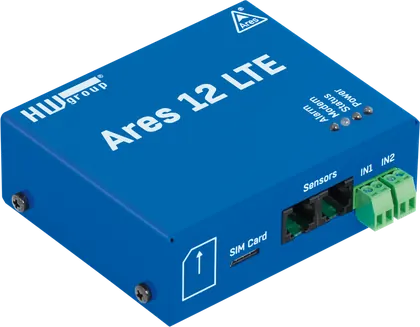
ARES12 LTE Set
The device sends its own alerts by SMS, phone call or email, without going through a portal. It comes with a 3 m probe, an antenna and a power supply, and its backup battery lasts about 24 hours in a power cut. All you need to add is a SIM card.
€587.70 excl. VATFor businesses only. Your EU VAT number is checked at checkout.
NB-IoT, SIM included
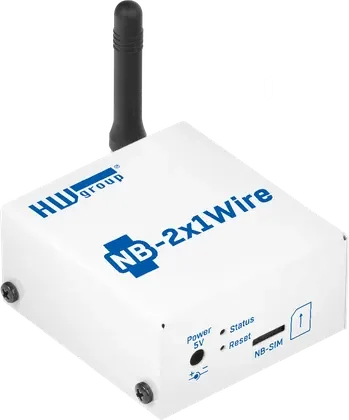
NB-2x1Wire Set
An NB-IoT device with a 3 m probe and a SIM card prepaid for 3 years. The battery lasts up to 3 years at one transmission every 10 hours. For faster alerts, run it from mains power.
€299.00 excl. VATFor businesses only. Your EU VAT number is checked at checkout.
NB-IoT, battery-powered
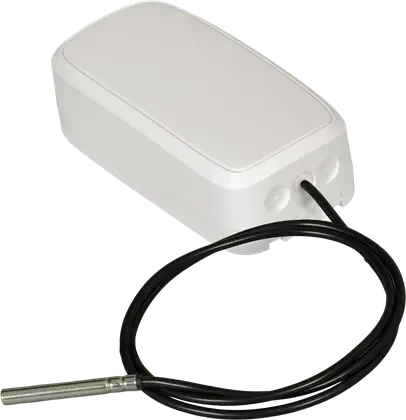
Efento NB-IoT Pack, external probe
A battery-powered wireless data logger in an IP65 enclosure, with a 1 m external probe. The price includes the SIM card and the Efento Cloud software for 5 years, and the sensor is yours to keep.
€216.00 excl. VATFor businesses only. Your EU VAT number is checked at checkout.
LoRaWAN, 4G gateway
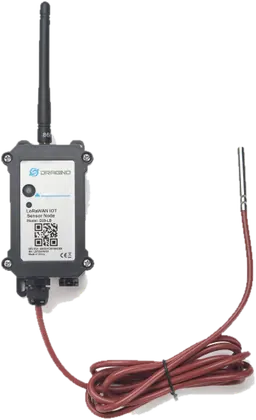
LoRaWAN Pack, from 5 sensors
Battery-powered sensors and an indoor 4G gateway, for monitoring several cold rooms on one site. This pack is available by quote only, priced according to your site.
Price on request
Where to place the probe
- Away from the airflow. Avoid the evaporator outlet, which gives a colder reading than the products themselves.
- Away from the door. A probe right next to the door reacts every time it opens.
- At product height. What matters is the temperature of the products, not of the ceiling.
- Device outside. The device stays outside and only the probe cable goes in, except for the Dragino sensor, which is designed for the cold.
Threshold and delay on a platform
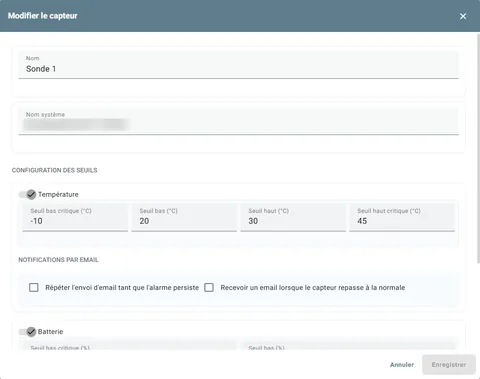
The platforms let you go further than a single threshold. Syclance offers 4 levels per sensor, SensDesk a safe range and notification ranges, and Efento Cloud rules that send alerts to different recipients depending on the threshold exceeded.
Frequently asked questions
Can the device go inside the cold room?
Generally not. The ARES device is rated for -5 to +50 °C and the NB-2x1Wire for -10 to +70 °C, so it stays outside and only the probe goes into the cold room. The Dragino D20-LB sensor is rated for -40 to +85 °C.
What happens during a power cut?
It depends on the pack. The ARES device runs for about 24 hours on its backup battery. Battery-powered sensors keep measuring, but the LoRaWAN gateway has no built-in battery. The optional IBPv1 battery keeps it going, according to Dragino's data.
Can I keep my existing alarm?
Yes. Our systems add a separate second reading and do not replace your system's own probe.
See also
Cold room alarm: thresholds, defrost, delay, who gets the alert
An alarm that goes off at every defrost ends up switched off. How to set the threshold, the delay and the recipients to avoid that.
Find out moreFree template: temperature record sheet and breakdown action plan
A PDF to print: morning and evening readings for a month, and a page for writing down in advance what to do in a breakdown. No registration needed.
Find out moreCold chain risks: breakdowns, power cuts, defrost cycles
The situations that push the temperature up without anyone seeing it, and what an alert can change in each case.
Find out more
Tell us about your site
Let us know what you want to monitor, where it is, and how many fridges or cold rooms are involved. We will reply with a quote.